the short version
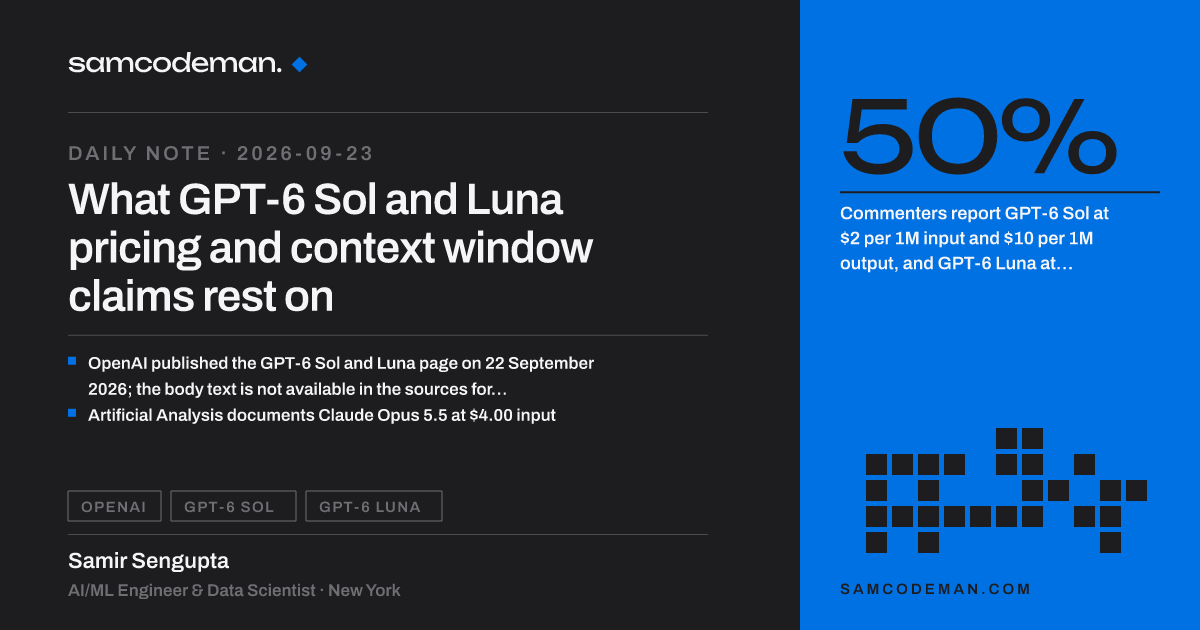
- The only per-token prices for GPT-6 Sol and Luna in these sources come from Hacker News commenters: Sol $2 in / $10 out, Luna $0.10 in / $0.50 out per 1M tokens, both described as 50% cuts on GPT-5.6.
- Claude Opus 5.5 is the one firmly documented comparator: $4.00 input, $20.00 output per 1M tokens, a 95% cache discount, a 1M token context window and $5.98 per Artificial Analysis Intelligence Index task.
- Cache read and write pricing, latency, tool-calling behaviour and Azure/AWS availability are unreported in every source here, and one commenter puts cache at 95%+ of the cost of agentic coding workloads.
- Epoch AI measures a 47% per quarter fall in the cost of a given level of AI performance, which is the reason model identifiers belong behind a config value with per-slot cost accounting.
OpenAI published a page titled "GPT-6 Sol and Luna" on 22 September 2026, and its body text is not available in the sources for this note. Every GPT-6 price and context figure below comes from commenters on Hacker News reading the launch: GPT-6 Sol at $2 per 1M input tokens and $10 per 1M output, GPT-6 Luna at $0.10 and $0.50, both described as 50% cheaper than the GPT-5.6 versions, and a 1M token context window. Latency and tool-calling behaviour are not described in any source here, for the GPT-6 models or for the comparator. Treat the prices as an input to a routing test you run yourself, not as a rate card you can budget against.
A production agent stack cares about four things when a model lands, and the coverage here is uneven across all four. Price per input and output token: commenter-reported only. Context limit: commenter-reported only, at 1M tokens. Latency: absent, and Artificial Analysis lists Speed as N/A even for the documented comparator. Tool-calling behaviour, including parallel calls, schema adherence and retry semantics: absent.
Where the GPT-6 Sol Luna pricing numbers come from
A commenter on Hacker News posted a comparison table showing GPT-6 Sol at $4 to $2 input and $20 to $10 output against GPT-5.6 Sol, and GPT-6 Luna at $0.20 to $0.10 input and $1.20 to $0.50 output against GPT-5.6 Luna, labelling both as 50% cheaper. Another commenter added that batch processing prices are still 50% off, which would put GPT-6 Sol and GPT-6 Luna output at $5 and $0.25 per 1M tokens, and linked to OpenAI's developer pricing docs. A third said the major difference is the 1M token context window, and that once you exceed 272K input tokens, Codex Sol is roughly the same price as Opus.
The table itself is disputed in the thread. One commenter read the same arrows as running the other way and asked whether the poster meant GPT-6 was 100% more expensive than 5.6. That is the level of confidence available here: a secondhand table whose direction of travel one reader could not resolve.
- Commenter claim: GPT-6 Sol $2 in / $10 out per 1M tokens, a 50% cut from GPT-5.6 Sol.
- Commenter claim: GPT-6 Luna $0.10 in / $0.50 out per 1M tokens, a 50% cut from GPT-5.6 Luna.
- Commenter claim: batch pricing remains 50% off, giving $5 and $0.25 output respectively.
- Commenter claim: a 1M token context window, with rough price parity against Opus above 272K input tokens.
- Not stated in any source here: cache read and write pricing, output tokens per second, tool-calling behaviour, Azure or AWS availability.
Claude Opus 5.5 is the confirmed $4/$20 comparator
Artificial Analysis documents Anthropic's Claude Opus 5.5, released September 2026, in its Adaptive Reasoning, Max Effort, Default Fallback configuration: $4.00 per 1M input tokens, $20.00 per 1M output tokens, a 95% cache discount, a 1M token context window, text and image input, text output. It scores 58 on the Artificial Analysis Intelligence Index v4.3.2, ranked 1 of 212 models in its class against a median of 25, and ranks 93 of 212 on cost. That is the only side of this comparison with a citable rate card.
On the cache line, a Hacker News commenter posted Claude Opus 5.5 at $0.20 cache reads and $5 cache writes per 1M tokens, against $0.50 and $6.25 for Claude Opus 5. The $0.20 read figure is consistent with the 95% discount Artificial Analysis lists on a $4.00 input price, but the cache write number appears only in the thread.
Cost per task, not cost per 1M tokens
Artificial Analysis reports that evaluating Claude Opus 5.5 on the Intelligence Index generated 260M output tokens against a median of 88M, roughly three times as verbose, and cost $5.98 per task. A model at half the price per token that emits three times the reasoning tokens is not half the price. One commenter made the same point: because of changes in tokenizers and thinking tokens, cost per token is not as helpful anymore as cost per task. If you are weighing Sol against Opus 5.5 for an agent loop, the measurement is dollars per completed task on your own traces.
The broader trend argues for the same instrumentation. An Epoch AI report from Emberson and Roodman, summarised at Marginal Revolution on 23 September 2026, puts numbers on the rate of change.
Over the past three years, the cost of a given level of AI performance has fallen an average of some 47% per quarter. That is a 13-fold drop every year – a faster rate than any other transformative technology in history.
Their worked example: OpenAI o3 cost about $0.30 per question to reach 75% on GPQA Diamond in January 2025, while GPT-5.6 Luna reached roughly the same score for $0.0004 in mid-2026, a roughly 725-fold decline in under 18 months. Note that Epoch is measuring cost to hold a fixed benchmark score, while the commenters are quoting list price per token; the two are not the same number and should not be chained together. The engineering consequence is the same either way: model identifiers belong behind a config value with per-slot cost accounting, not hardcoded in a prompt module.
Which model slots should move first
Assuming the commenter figures survive contact with the published pricing page, the slot moves fall out in a specific order.
- High-volume classification, routing and extraction: Luna at a claimed $0.10 in / $0.50 out is the slot most worth testing first. One commenter argued it is cheap and smart enough to do many agentic tasks, cheap enough to put on a website without auth, which is a security decision as much as a cost one.
- Offline and batch jobs: at a claimed $0.25 per 1M output tokens under the 50% batch discount, nightly enrichment and backfill workloads have the largest absolute saving and the lowest blast radius if quality regresses.
- Long-context retrieval over 272K input tokens: the commenter claim is that Codex Sol is roughly the same price as Opus past that threshold, so the routing rule is a token-count branch rather than a blanket swap.
- Cache-heavy agentic coding: hold. One commenter asked whether cache read and write dropped by 50% or similar, noting that is where most of the cost sits for agentic coding workloads, 95% or more. Nothing in these sources answers that.
For scale on what the cache question is worth, Artificial Analysis lists a 95% cache discount on Claude Opus 5.5's $4.00 input price. A 50% cut to uncached input tokens changes very little for a harness that replays a long system prompt and file tree on every turn.
What practitioners are pushing back on
The first unanswered question in the thread was deployment surface. One commenter noted the announcement says nothing about availability on either Azure or AWS, assumed it would show up later, and said it would be interesting if it did not. Another flagged a plan-side constraint: Anthropic still has a $200/month 20x plan while, since 11 September, OpenAI does not and has given no ETA for its return, leaving that commenter unable to upgrade from the $100/month tier and considering a switch back to Claude. Neither point is addressed by anything in these sources.
The second theme is quality rather than price. One commenter said they would rather keep 5.6 Sol and have it further optimised, and was not sure they would like 6 Sol if it resembles Astra. Another described using Fable to reason and spawning Opus subagents, and said Codex is behind Claude Code on features like seeing what subagents are doing. A third reacted to the idea of running Luna after a goal for 10 days by comparing it to letting a wild animal out into your code base.
There is also direct scepticism about the prices themselves. One commenter argued they do not necessarily reflect actual costs, since OpenAI is not profitable, and that the cut is a move to regain a market lead. Another questioned whether the prices are inference-profitable at all. Both are opinions from the thread, not findings; no source here reports OpenAI's margins.
What is still unknown as of 23 September 2026
No latency figure exists for either GPT-6 model here. Artificial Analysis lists Speed as N/A for Claude Opus 5.5 as well, so even the comparator has no output tokens per second on record. Tool-calling behaviour, including parallel calls, schema adherence and retry semantics, is not described in any source given. The 1M context window, the 272K parity point and every price above remain commenter readings of an announcement whose text is not retrievable here.
Keep some scepticism in reserve while the numbers firm up. Writing in MIT Technology Review's The Download on 23 September 2026, Timnit Gebru, executive director of the Distributed AI Research Institute, and Emily M. Bender, professor of linguistics at the University of Washington, argue there is a strong commercial incentive to overstate AI capabilities, and that the illusion of speed and urgency promulgated by tech companies is itself a way to misdirect policymakers and the public. That is not an argument against a 50% price cut, which is checkable on an invoice. It is an argument for checking the invoice, running your own cost-per-task numbers before moving a slot, and waiting for the cache pricing line before you move the slot that matters most.
Questions this raises
How much do GPT-6 Sol and Luna cost per token?
Hacker News commenters quote GPT-6 Sol at $2 per 1M input tokens and $10 per 1M output, and GPT-6 Luna at $0.10 and $0.50, each a 50% cut from the GPT-5.6 versions. Batch pricing is said to remain 50% off, giving $5 and $0.25 output. None of these figures come from the announcement text itself, and one commenter read the same comparison table as running the opposite direction.
What is the GPT-6 context window?
A commenter described a 1M token context window as the major difference, and added that past 272K input tokens Codex Sol is roughly the same price as Opus. That figure is commenter-reported only. Claude Opus 5.5 also carries a documented 1M token context window per Artificial Analysis.
Is GPT-6 Luna cheaper than Claude Opus 5.5 for agent workloads?
On list price per token the claimed Luna figures are far below Opus 5.5 at $4/$20, but cost per token is not cost per task. Opus 5.5 emitted 260M output tokens on the Intelligence Index against a median of 88M, about three times as verbose, at $5.98 per task. Measure dollars per completed task on your own traces before switching slots.
These daily notes are drafted by a model I run and operate myself - the same kind of pipeline this site is about - from sources published in the previous 24 hours, and every one lists what it read. The longer essays, the talks and the preprint are mine, written by hand.