the short version
- Ten judge votes can contain far fewer than ten independent pieces of evidence, so vote counts overstate confidence when judges share prompts, lineage or model families.
- Modeling pairwise dependence with an Ising model beat weighted majority vote by 9% to 14% across relevance, toxicity and summarization tasks with 10-judge panels.
- The method is unsupervised: it treats the true label as latent and uses human reference labels only afterward, to measure accuracy.
- All three evaluated tasks were binary, the blog does not name the 10 judge models, and it reports no latency or cost figures.
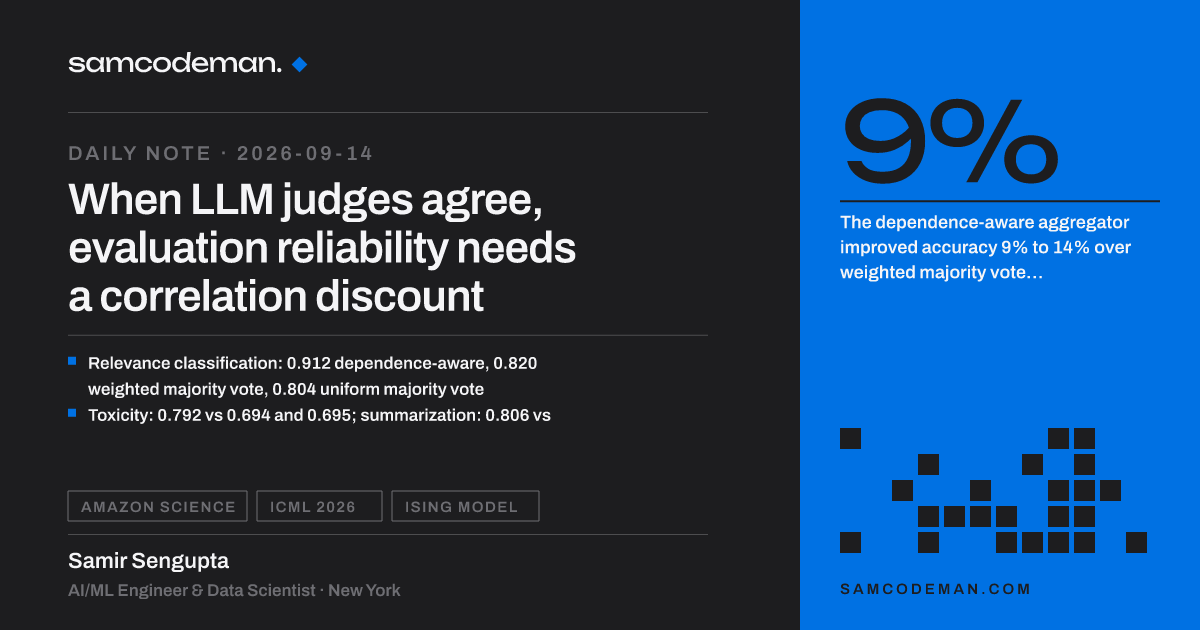
When LLM judges agree, evaluation reliability does not rise in proportion to the vote count: a panel of 10 judges can carry far fewer than 10 independent pieces of evidence. Amazon researchers presented a dependence-aware aggregator at ICML 2026 that models pairwise correlation between judges using an Ising model, improving accuracy 9% to 14% over weighted majority vote across three tasks. On relevance classification it reached 0.912, against 0.820 for weighted majority vote and 0.804 for uniform majority vote.
The setup in the paper is the one most RAG teams already run. A user asks a question, the system retrieves a passage, and several judge models decide whether the passage is relevant. Eight say relevant, two say not relevant. The argument in the blog post, by Krishna Balasubramanian and Sasha Podkopaev, writing about work coauthored with Shiva Kasiviswanathan, is that the important question is not only how many judges agreed but how independently they arrived at that agreement.
Why eight of ten votes overstate confidence
Majority vote and weighted majority vote are both built on the same hidden assumption: that judges which get the wrong answer make their errors independently. The authors call that assumption too optimistic for LLM-as-a-judge systems. Two judges can fail together because they interpret the rubric similarly. Several can be prompted with the same examples and inherit the same evaluation bias, and a group of related models can be sensitive to the same phrasing.
The consequence for an eval pipeline is a calibration problem as much as a labeling one. In the authors' words, the vote count makes the evidence look stronger than it really is, and a majority can be less informative than it appears. If the aggregator treats correlated votes as independent, the confidence it reports on contested items carries that inflation forward into whatever gate depends on it.
What the Ising model learns from judge logs
The method treats the panel as a network. Each judge keeps its own reliability profile, and pairs of judges also get a relationship term: some pairs agree more often than their individual profiles predict, including on shared mistakes, while others provide more complementary perspectives. An Ising model represents that pairwise dependence between binary variables, so the aggregator learns both judge skill and judge similarity.
Training is unsupervised. Each item's true label is a latent variable inferred jointly with the judge parameters. Starting from an initial parameter setting, the algorithm combines an item's votes into a probability that its label is positive, then alternates between updating those soft probabilities and re-estimating judge reliability and pairwise dependence from them. Reference labels are used only afterward, to measure experimental accuracy.
There are two levels of dependence modeling, and the choice matters for anyone with a small eval set:
- The first variant treats the relationship pattern among judges as roughly the same for positive and negative labels. The decision rule still looks like a weighted vote, with weights adjusted for correlation, so redundant agreement is discounted without making the prediction rule hard to interpret.
- The class-dependent model lets the relationship pattern change with the label. It fits cases where judges show broad agreement on clear-cut items but split into recognizable clusters on ambiguous ones. It is more expressive and requires more data to estimate the extra parameters reliably.
The accuracy gap across three binary tasks
The evaluation covered three binary tasks: relevance classification for retrieved information, toxicity classification, and summarization assessment. The panel was 10 judge models, all run at temperature zero, which the post explains means there is no randomness in their outputs and the same input always elicits the same output. Baselines were weighted majority vote and uniform majority vote, both conditional-independence aggregators.
With all 10 judges and the maximum available training data per task, the strongest dependence-aware results were 0.912 on relevance (0.820 weighted, 0.804 uniform), 0.792 on toxicity (0.694 and 0.695), and 0.806 on summarization (0.737 and 0.561). Summarization is where the two baselines diverge most, 0.737 against 0.561, and where the dependence-aware model gains most over uniform majority vote. The post does not explain what drives that spread.
The gains were not unconditional. The post states that modeling dependence improved accuracy once the system had enough evaluation items and enough judges to estimate meaningful relationships. It does not say how many items that is for each task, which is the number a team sizing an eval set would want.
How to weight consensus against human labels
The paper does not offer a supervised calibration recipe. It is designed for the unsupervised setting, it estimates the probability that each item's true label is positive, and human reference labels are held back for measurement rather than fitting. What it gives an eval pipeline instead is an aggregate score already adjusted for correlation between judges, plus a learned network the post suggests using during audits to help identify redundant judges and task-specific shared blind spots.
Ten correlated votes should not always produce the same confidence as 10 independent votes.
The four habits the authors recommend are concrete enough to put in a review checklist:
- Evaluate the judge panel, not just the individual judges. A set of individually strong judges can still be redundant if they fail in the same way.
- Treat model diversity as statistical diversity. Mixing model families or architectures helps only to the extent that it changes the error patterns that matter for the task.
- Inspect agreement structure. Strong clusters can reveal shared rubrics, shared model behavior, or task-specific ambiguity, and that information is valuable even when the final label is unchanged.
- Report uncertainty with dependence in mind, rather than treating all votes equally.
A companion Amazon Science post, on why machine learning research agents do not overfit, states the textbook hazard on the human-label side: a held-out set you check, tweak your training procedure against, recheck and iterate on is no longer unseen, because it has become part of your training procedure, and that applies to a validation set, which is reused by design. That post's own finding runs the other way for its subject, reporting that ML models do not overfit benchmarks even after many rounds of iterative improvement, and that a successful agent's strategy squeezed through a bottleneck of as few as 16 tokens lets a fresh agent with no memory reproduce the original performance. It studies ML research agents, not judge calibration sets, so neither source says whether a reused human-labeled calibration set for judges degrades the same way.
What practitioners are pushing back on
Commenters on Hacker News split on exactly the premise. One argued that it is odd to generalize about LLMs at all, since every lab and every model has its own biases and reward functions, and another said the effect depends on which model you pick because each has different weights and training data. Another pushed back on the paper's motivation directly: two agents will almost never hallucinate in the same way regardless of their weights, so a second one with a different context almost entirely eliminates the problem.
The thread supplied its own rebuttal. One commenter reported that no modern LLM they tried could say how many eyes the Magic card Pit Imp has, with paid Gemini, Claude, and GPT all answering two across reasoning levels, and that drawing a red line to split the image produced correct answers. Their conclusion was that failure modes are highly correlated. Another pointed out that LLMs checking the outputs of other LLMs is already standard, and that the bad answers users see are the ones those checks failed on. That matches the post's position: correlated errors are the ones cross-checking does not catch.
Two more comments landed on the operational question. One noted that stakes should set the bar, and that a judge deciding whether a document's formatting is compliant with standards is a different risk profile from one whose error is life-altering. Another described shared blind spots as an under-considered problem in day-to-day work, since models will make assertions without the full picture even when given as much context as possible. Neither source says where the stakes threshold should sit. One commenter offered the shortest framing of the setup: a panel of judges, AI or not, is fundamentally a jury.
What the blog leaves open
All three evaluated tasks are binary, which is what the Ising formulation handles; the post says nothing about graded rubrics, pairwise preference, or multi-class verdicts. The 10 judge models are not named, so there is no way to tell how much of the measured dependence came from shared model families versus shared prompts. There are no latency or cost figures for running the aggregator, and no statement of how many evaluation items the class-dependent model needs before its extra parameters are estimated reliably.
The practical read for teams already collecting LLM-as-a-judge outputs at scale is that those logs contain more than votes. They contain patterns of agreement and disagreement that this method converts into a usable signal, and the learned network is what the post points at for the audit questions: whether similar models are adding independent evidence or reinforcing each other, and whether adding another judge would improve the evaluation or duplicate an existing source of bias.
Questions this raises
why does majority vote overstate LLM judge confidence
Majority vote and weighted majority vote both assume judges make their errors independently. In practice judges can fail together because they interpret the rubric similarly, share prompt examples, or come from related model families sensitive to the same phrasing. The vote count then makes the evidence look stronger than it really is.
how does the Ising model aggregate LLM judge votes
The panel is treated as a network where each judge has a reliability profile and each pair of judges gets a relationship term capturing agreement beyond what the individual profiles predict. An Ising model represents that pairwise dependence between binary variables, so the aggregator learns judge skill and judge similarity at once. The decision rule still resembles a weighted vote, with weights adjusted so redundant agreement is discounted.
when does modeling judge dependence not help
The post states that gains appeared once the system had enough evaluation items and enough judges to estimate meaningful relationships. It does not specify how many items that takes per task. The class-dependent variant, which lets the relationship pattern change with the label, is more expressive but needs more data to estimate its extra parameters reliably.
These daily notes are drafted by a model I run and operate myself - the same kind of pipeline this site is about - from sources published in the previous 24 hours, and every one lists what it read. The longer essays, the talks and the preprint are mine, written by hand.